
At its core, the damping factor of an amplifier is a measure of how well the amplifier can control the physical movement of a loudspeaker. When an audio signal plays, it forces the speaker cone to move back and forth. However, once that signal stops, the cone's own mass and elasticity naturally cause it to keep vibrating or bouncing, much like a spring. The damping factor determines the amplifier's ability to act as an electrical brake, stopping that unwanted movement immediately.
How Damping Factor is Calculated
Technically, the damping factor is a dimensionless ratio calculated by dividing the nominal impedance of the speaker (such as 8 ohms) by the internal output impedance of the amplifier. Because the amplifier's output impedance is typically a tiny fraction of an ohm, the resulting damping factor number is usually quite high, often ranging from 50 to several hundred or even thousands in modern solid-state amplifiers.
Firstly, we need to calaculate the output impedance of the amplifier. A simple way to do this is injecting a sinewave of 100Hz into the amplifier and bring it to about half-power output. Measure what the AC RMS voltage of the amplifier is at its output first unloaded, then loaded with a load (such as 8 ohms). There should be a difference of a few millivolts in the measurements. It's also best to measure the voltage directly at the amplifier's output and not at the load.
To calculate the output impedance:
Zout = Rload * (V_unloaded - V_loaded) / V_loaded
for a practical demonstration, we'll say the unloaded voltage is 3.059V RMS and the loaded voltage is 3.046V RMS; therefore:
Zout = 8 * (3.059 - 3.046) / 3.046
Zout = 0.034 ohms (34 milliohms)
To calculate the damping factor:
DF = Rload / Zout
in this case:
DF = 8 / 0.034
DF = >235 (@ 100Hz)
Why It Matters for Sound Quality
A high damping factor means the amplifier has a very tight electrical "grip" on the speaker drivers. This control is especially critical for low frequencies, where heavy speaker cones require precise management. When the damping factor is high, bass notes sound tight, punchy, and well-defined. If the damping factor is too low, the amplifier fails to control the speaker's inertia properly, leading to a "boomy", muddy, or smeared low-end response where notes bleed into one another.
Practical Considerations in Audio Systems
While solid-state amplifiers generally boast very high damping factors, tube amplifiers naturally feature higher output impedances, resulting in much lower damping factors. Interestingly, many audiophiles actually prefer the sound of lower damping factors because the slightly looser cone control can introduce a warmer, more resonant, and organic character to the music.
Calculator Application
I wrote a quick application in Visual Studio C++ MFC (Microsoft Foundation Classes) to make it a little simpler to calculate both output impedance and damping factor without the need to memorise the fomula. See the screenshot below.
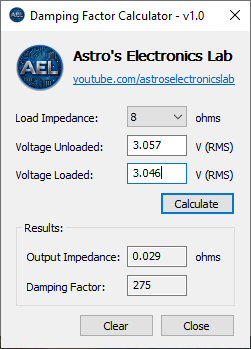
It currently runs on Windows 10 x64 (in Win32 mode), and should run on Windows 11 x64 just fine. You can download the zip file containing the binary below. Be sure to extract it to a folder, such as Documents, rather than trying to run the application without unzipping it. This tends to fire-off Windows Defender each time.