
This circuit is an electronic sound and visual effects generator designed to simulate the rapid firing and muzzle flash of a machine gun. Powered by a 9V battery connected through terminal J2, it combines an audio tone generator with a synchronized flashing LED indicator.
Circuit Description
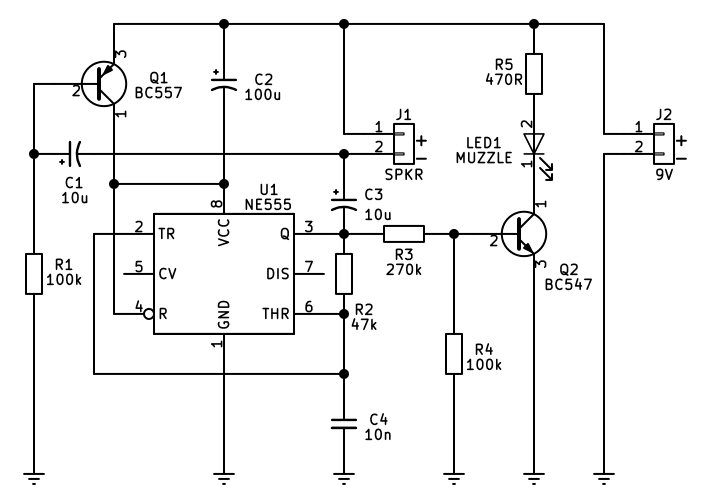
The core audio frequency is generated by U1, an NE555 timer configured as an astable relaxation oscillator. Resistor R2 and capacitor C4 govern the base timing of this oscillator, setting the fundamental pitch of the gunshot sound. However, instead of being connected directly to the constant 9V supply, the timer receives its power and reset bias dynamically through a gating network.
The staccato machine-gun burst effect is created by this gating network, which consists of transistor Q1 (a BC557 PNP transistor), resistor R1, and capacitors C1 and C2. When power is applied, R1 pulls the base of Q1 low, turning it on and supplying voltage to the timer. As the timer starts oscillating, its output pulses at pin 3 are fed back through capacitor C1 to the base of Q1. This feedback rapidly toggles Q1 on and off. Capacitor C2, connected across Q1, acts as an envelope-shaping reservoir. When Q1 is momentarily turned off by the feedback, C2 supplies a rapidly decaying voltage to the timer. This chokes off the oscillation smoothly rather than abruptly, creating the distinct, repetitive bursts and decaying audio envelope characteristic of automatic gunfire.
These audio bursts are fed directly from the timer's output to a small speaker connected at terminal J1, producing the rat-tat-tat sound effect.
Simultaneously, the output pulses from pin 3 are coupled through a voltage divider formed by resistors R3 and R4 to the base of transistor Q2 (a BC547 NPN transistor). Transistor Q2 functions as a high-speed electronic switch that drives LED1 in perfect synchronization with the audio bursts. LED1 acts as the muzzle indicator and should be a fairly high-brightness LED to effectively mimic the intense, blinding flash of a real machine gun. Resistor R5 is included in series with the LED to limit the current and ensure safe operation during these rapid flashes.