
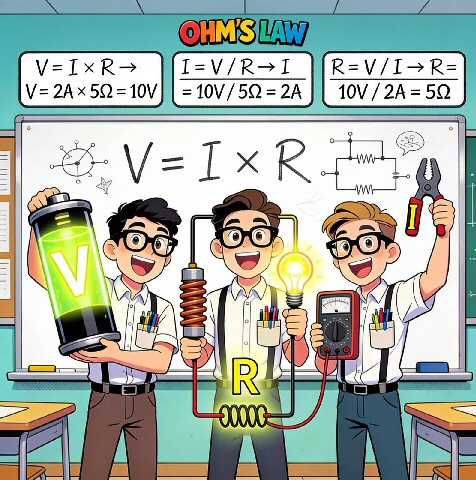
Ohm's law is one of the basic rules of electronics. It explains the relationship between voltage, current, and resistance in an electrical circuit. It is used to calculate how electricity flows through components such as resistors, LEDs, and wires.
Ohm's law is written as:
V = I * R
Where:
- V = Voltage (volts)
- I = Current (amps)
- R = Resistance (ohms)
This means that voltage equals current multiplied by resistance.
What the Terms Mean
Voltage
Voltage is the electrical force that pushes electrons through a circuit.
Current
Current is the flow of electricity through a circuit.
Resistance
Resistance slows down or limits the flow of current.
Using Ohm's Law
The formula can be rearranged depending on what you need to calculate.
To find current:
I = V / R
To find resistance:
R = V / I
Example
If a 12V battery is connected to a 6 ohm resistor in parallel and we want to find the current:
I = 12 / 6
The answer is:
I = 2A
So, 2 amps of current flows through the resistor.
Why Ohm's Law is Important
Ohm's law is used to:
- Design electronic circuits
- Choose resistor values
- Calculate current and voltage
- Prevent components from being damaged
Power Law
The "power" law is one of the fundamental relationships in electronics and electrical engineering, and an extension of Ohm's law. It describes the rate at which electrical energy is being transferred or converted within a circuit.
The basic relationship is:
P = V * I
where P is power in watts, V is voltage in volts, and I is current in amperes.
The power law is particularly important because voltage and current by themselves don't tell us how much energy a component (such as a resistor) is actually handling. A component can have a high voltage across it but very little current flowing through it, or a relatively low voltage with a large current. It is the combination of the two that determines the power. For example, a component with 20V across it and 2A flowing through it is handling 40 watts of electrical power.
In a resistor, electrical power is primarily converted into heat. In a loudspeaker, it is converted into mechanical movement and ultimately sound. In an electric motor, it is converted into mechanical energy. In a light-emitting device, it is converted into light as well as some heat. Power therefore gives us a way of describing what is actually happening to electrical energy as it moves through a circuit.
The power law is also critically important when designing electronic circuits because every real component has limits on how much power it can safely handle. Exceeding those limits can cause excessive temperature rise, component failure or, in extreme cases, catastrophic damage (including smoke - if not fire). A resistor might have the correct resistance and be operating at the correct voltage and current, for example, but if it is dissipating more power than its rated wattage, it can overheat and fail. Understanding power is therefore just as important as understanding voltage and current when determining whether a circuit will operate reliably.
This is why the power law is such an important extension of the basic electrical relationships used in electronics. It moves us beyond simply describing the electrical conditions in a circuit and allows us to understand energy transfer and component stress. Voltage tells us about electrical potential, current tells us about the movement of charge, and power tells us the rate at which electrical energy is being transferred as a result.
The power law can also be rearranged to calculate either current or voltage when the other two quantities are known. If we know the power and voltage, the current can be found using I = P / V. Conversely, if we know the power and current, the voltage can be calculated using V = P / I. These forms are particularly useful when determining the current required by a load of a known wattage, or the voltage required to deliver a particular amount of power.
Both Ohm's law and the power law are two of the most important tools in electronics and is used in everything from simple circuits to modern electronic devices.